

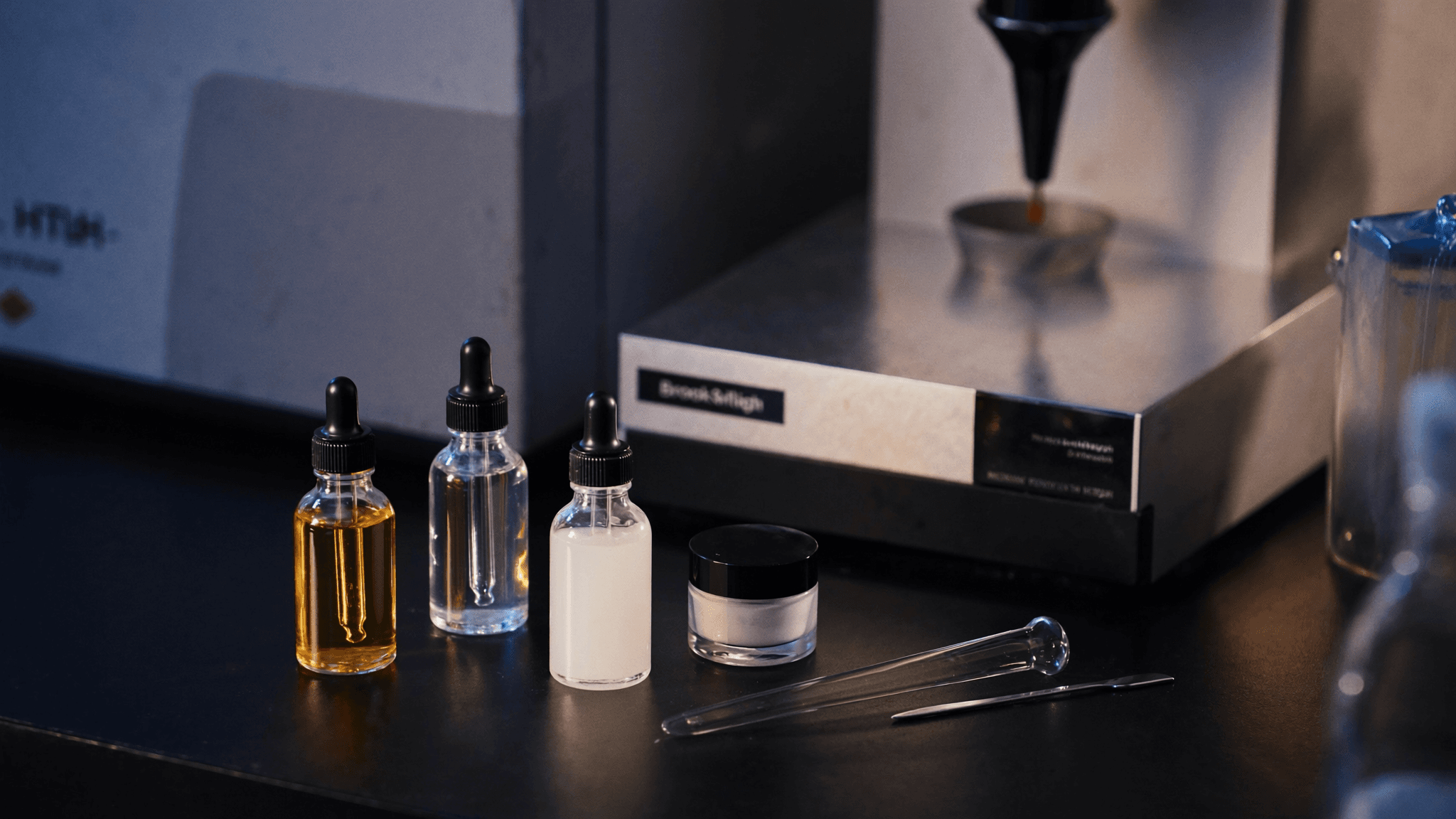
Five organisms. Four timepoints. One pass.
A preservative system is only proven by challenging it: we inoculate the finished formulation with the compendial bacteria, yeast, and mold, then count survivors at days 7, 14, 21, and 28 to confirm the required log-reduction and no regrowth.
Published. Per-test.
No quote calls.
Every assay a la carte, every panel bundled. Bulk discount at 5+ samples. Prices below reflect a single-compound submission.
5-organism, 28-day, neutralization validation.
- USP <51> 5-organism challenge
- Log-kill at days 7/14/21/28
- Neutralization validation
- Public COA + accession #
Both compendia.
- USP <51> challenge
- ISO 11930 challenge
- US + EU/global acceptance
- Public COA + accession #
PET + microbial limits.
- USP <51> preservative efficacy
- Microbial limits (USP <61>)
- Neutralization validation
- Public COA + accession #
Where PET fails.
Most challenge-test failures aren't random; they cluster around under-preserved "clean" formulas, mold at the back of the window, high-water emulsions, and packaging that reintroduces contamination.
USP <51>, ISO 11930, MoCRA, ISO 17025 Aligned.
The challenge test is the same idea worldwide, but the acceptance criteria and the regulation that requires it differ by market. Here's what we map to.
The US compendial preservative challenge — five standard organisms, category-specific log-reduction criteria at days 7/14/21/28. Required by every major US retailer for new-SKU onboarding.
The international cosmetic preservation-efficacy standard with Criteria A/B acceptance, expected for products entering EU and many global retail channels.
The Modernization of Cosmetics Regulation Act requires adequate safety substantiation; PET is a core analytical input to that file for any water-containing product.
The baseline bioburden and specified-organism screens run alongside PET for a complete microbiological picture.
Documented organism preparation, neutralization validation, and recovery QC; operated to ISO/IEC 17025 expectations (we do not currently hold formal ISO 17025 accreditation).
PET, also called a challenge test or antimicrobial-effectiveness test, deliberately inoculates a finished water-containing formulation with standard bacteria, yeast, and mold, then counts survivors at days 7, 14, 21, and 28. Passing proves the preservative system controls contamination over the product's in-use life. We run it to USP <51> and ISO 11930.