Peptide purity, identity and net content testing
Research peptides are sold by purity, but purity alone does not say what is in the vial. We pair reversed-phase HPLC-UV at 214 nm with triple-quadrupole LC-MS/MS identity on every sample, and offer net peptide content as a separate $29 add-on, measured against a reference standard so the milligram on the label can be checked. Endotoxin and sterility are reported on the same accession, and the certificate names the lab that performed each.
- From
- $189
- Certificate
- Public, hashed, video-linked
What the panel measures
| Test | Method | Instrument | Reports as |
|---|---|---|---|
| Identity | MethodLC-MS/MS, ESI+, charge-state m/z and MRM transitions | InstrumentAgilent 6490 Triple Quadrupole LC/MS | Reports asObserved m/z vs theoretical, ±0.1 Da; pass/fail |
| Purity | MethodRP-HPLC-UV 214 nm, C18 sub-2 µm, 5–95% acetonitrile gradient | InstrumentAgilent 1290 Infinity II UHPLC | Reports asArea % of main peak; chromatogram on certificate |
| Net peptide content | MethodHPLC-UV quantitation vs certified reference standard | InstrumentAgilent 1290 Infinity II UHPLC | Reports asmg per vial and % of label claim |
| Counter-ion | MethodTFA and acetate by LC-MS/MS | InstrumentAgilent 6490 Triple Quadrupole LC/MS | Reports as% w/w; add-on |
| Water content | MethodKarl Fischer coulometric | InstrumentKarl Fischer titrator | Reports as% w/w; add-on |
| Endotoxin | MethodUSP <85> kinetic chromogenic LAL with PPC; Charles River-calibrated cartridges | InstrumentCharles River Endosafe nexgen-PTS, three units | Reports asEU per vial and EU/mg; add-on $199 |
| Sterility | MethodUSP <71> membrane filtration, FTM and SCDM, 14 days | InstrumentMilliporeSigma Steritest Equinox, two units | Reports asNo growth / growth; add-on $195 |
| Heavy metals | MethodUSP <232>/<233> by ICP-MS | InstrumentAgilent 7850 ICP-MS | Reports asµg/g for Pb, As, Cd and Hg; add-on $169 |
Accepted: Lyophilised vials Reconstituted vials Raw powder Pre-filled pens
Compounds: Semaglutide Tirzepatide Retatrutide Cagrilintide BPC-157 TB-500 CJC-1295 Ipamorelin Tesamorelin GHK-Cu PT-141 Melanotan II Selank Semax NAD+ MOTS-c Epithalon KPV LL-37
Sample requirements and shipping
What to send, how to pack it, and what the intake team records when it arrives.
- 1One sealed vial per test, as sold. Do not reconstitute or open it. We weigh the vial, reconstitute a known volume and quantify against a certified reference standard; an opened vial cannot yield a net content figure.
- 2Destructive add-ons need their own vial from the same lot. Endotoxin and sterility share one; heavy metals, residual solvents, TFA and 7-day stability each take one. The intake builder counts them for you.
- 3Lyophilised peptides ship at room temperature in a padded mailer on the prepaid UPS Ground label we email when payment lands. Reconstituted vials and pens should ship Monday to Wednesday with a cold pack.
- 4Write nothing on the vial except the lot. Intake assigns a blind code on camera; the analyst never sees the client name or the vendor.
- 5Keep one vial from the same lot yourself. If a result surprises you, that vial is what a second laboratory would need, and our retained portion is kept about 90 days for verification and review.
Peptide testing prices
Tests
| Test | Method | Price |
|---|---|---|
| Identity by LC-MS/MS and purity by HPLC-UV, together | MethodAgilent 6490 and 1290; the pair most buyers order | Price$189 (GLP-1 class $289) |
| Identity alone | MethodLC-MS/MS, ±0.1 Da | PriceIncluded with base identity and purity |
| Purity alone | MethodRP-HPLC-UV 214 nm (VWD), area percent | PriceIncluded with base identity and purity |
| Net peptide content vs certified reference standard | Methodmg of active peptide per vial and % of label claim | Price+$29 |
| Endotoxin, USP <85> | MethodDestructive; extra vial | Price+$199 |
| Sterility, USP <71>, 14-day | MethodSeparate extra vial required | Price+$195 |
| Heavy metals, ICP-MS, USP <232>/<233> | MethodDestructive, needs a second unit; extra vial | Price+$169 |
| Karl Fischer water content | MethodCoulometric titration, % w/w | Price+$49 |
| Trifluoroacetic acid (TFA) by ion chromatography | MethodResidual TFA counter-ion, LOQ 0; extra vial | Price+$179 |
| Residual solvents, USP <467>, GC-MS | Method16 analytes, reported against LOQ; extra vial | PriceConfirm scope and pricing |
| Enclosure integrity, vial vacuum in PSI | MethodMeasures the residual vacuum of the sealed vial before opening; reported in PSI | PriceConfirm scope and pricing |
| Solubility, reconstitution check | MethodEach vial must dissolve completely into a clear solution at 2 mL water | PriceConfirm scope and pricing |
| Post-reconstitution stability, 7-day | MethodVial is reconstituted in bacteriostatic water at the stated concentration and re-assayed at 0, 3 and 7 days at 2–8 °C; extra vial | PriceConfirm scope and pricing |
| Conformity, extra vials for lot variance | MethodIdentity, purity and net content repeated on 2 or more vials from the lot | Price+$75 per extra vial |
Build a current quote
Choose the compound and assays in the current intake for an itemized quote. View current pricing.
The base assay includes identity and purity. Compound-specific prices and selected add-ons are shown in the current intake before payment. Net peptide content is a separate $29 add-on, including for GLP-1 compounds. Optional service upgrades are priced in the intake form.
Why the method matters
Identity is not optional here
A UV detector cannot tell a 99% pure wrong peptide from the right one; a single-residue substitution in a 39-residue GLP-1 analog can co-elute with the target. Every peptide panel includes LC-MS/MS identity to ±0.1 Da on an Agilent 6490 triple quad. Many labs sell identity as an upsell or omit it.
Net content, not just purity
Purity is a ratio; net peptide content is the milligram in the vial measured against a certified reference standard. We report both, so a 99% pure 3 mg vial labeled 5 mg is caught.
Compendial endotoxin and sterility
Endotoxin is kinetic chromogenic LAL per USP <85> on Charles River Endosafe cartridges; every cartridge is calibrated and certified by Charles River itself, with the standard curve and positive product control built in, so there is no in-house lysate reconstitution to go wrong. Sterility is the full 14-day USP <71> membrane-filtration culture in both media, not a rapid screen, and the certificate names the laboratory that ran it.
Authentic Agilent bench, OEM consumables
Every instrument was bought new through Agilent, Charles River and MilliporeSigma authorized channels, installed and performance-qualified by certified engineers, and serviced by Quantum Analytics. Columns, lamps, seals, cartridges, canisters and reference standards are OEM or Thermo Fisher lot-traced; no third-party refills, no re-used cartridges, no expired lysate. The instrument ID, column lot and standard lot are printed on every certificate.
How each result is produced
The purity number
Purity is an area-percent figure: the main peak’s area divided by the total area of every peak in the chromatogram. We inject onto a sub-2 µm C18 column on an Agilent 1290 Infinity II and run a water and acetonitrile gradient with 0.1% TFA, detecting at 214 nm where the peptide bond absorbs. The variable wavelength detector reads 214 nm only, so purity is reported as area percent at that wavelength, without a spectral peak-purity claim. Integration follows a written SOP and a second analyst reviews it.
Identity
Ultraviolet detection cannot distinguish a 99% pure wrong peptide from the right one, so identity is run separately by electrospray LC-MS/MS on an Agilent 6490 triple quadrupole. The peptide produces a series of multiply charged ions; we compare their observed m/z with the values calculated for the declared sequence and confirm them with MRM fragment transitions. Agreement within ±0.1 Da passes. A single amino-acid substitution or a leftover protecting group shifts the mass and fails.
Net peptide content
A vial labelled 5 mg at 99% purity can hold well under 5 mg of peptide. The gross powder includes counter-ion (TFA or acetate), residual water and bulking agents such as mannitol. Net peptide content weighs what is in the vial, reconstitutes a known volume and quantifies the peptide against a certified reference standard, then reports milligrams per vial and percent of label. It is the number to compare with the label, and the one most certificates leave out.
Endotoxin and sterility for anything injected
Endotoxin is run by kinetic chromogenic LAL on Charles River Endosafe nexgen-PTS readers with single-use cartridges calibrated by Charles River; every sample carries a positive product control so inhibition or enhancement cannot hide a result. The limit is calculated from the intended dose per USP <85>. Sterility follows USP <71>: closed-system membrane filtration on MilliporeSigma Steritest units in a class II biosafety cabinet, two media, fourteen days of incubation. Both run in this building on the same accession as the chemistry.
When a sample fails
A failing result is published the same day as a passing one, with the same chromatogram and signature. We do not re-run to find a better number. If you believe a result is wrong, tell us while we still hold the retained portion of your sample, which we keep for about 90 days. We review the data and, where warranted, rerun it or send it to another laboratory, and we correct the certificate publicly if we were wrong.

The bench this runs on
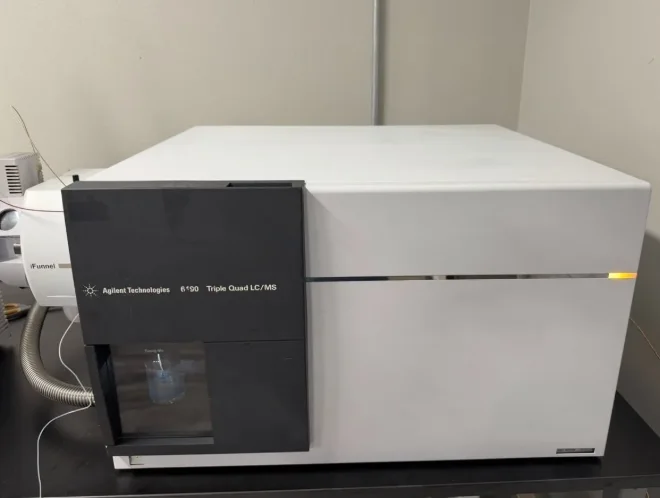
Agilent 6490 Triple Quadrupole LC/MS
Identity by precursor m/z and MRM transitions; sub-ppt quantitation with isotope dilution.
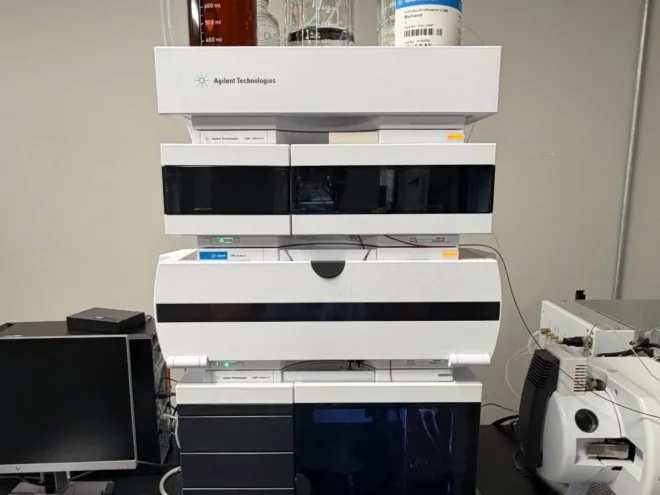
Agilent 1290 Infinity II UHPLC
Purity and potency by UV (G7114A VWD); 1300 bar, sub-2 µm columns.
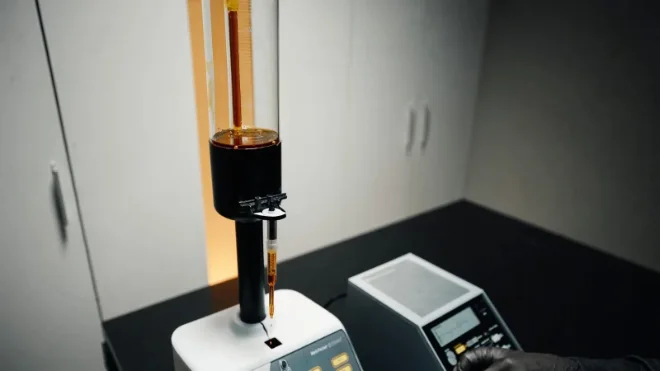
Karl Fischer titrator
Water content of lyophilised peptides and raw materials.
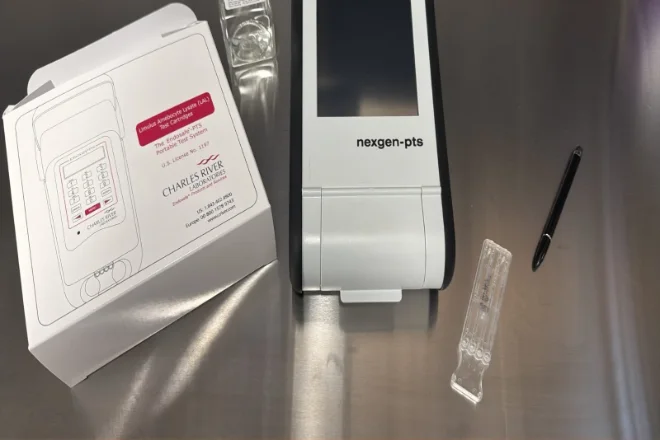
Charles River Endosafe nexgen-PTS, three units
Rapid USP <85> endotoxin on single-use cartridges; each cartridge is calibrated and certified by Charles River, with the standard curve and positive product control built in.
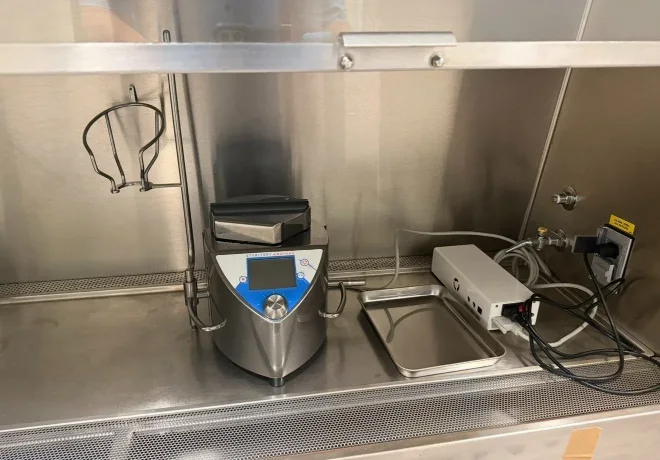
MilliporeSigma Steritest Equinox, two units
USP <71> sterility by membrane filtration in a class II cabinet.
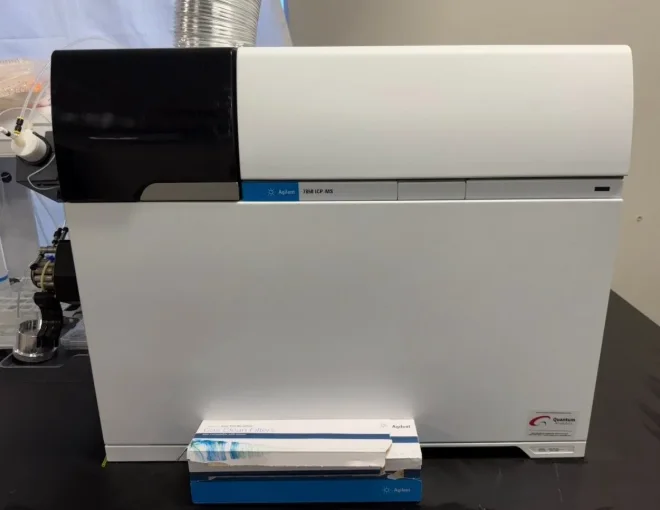
Agilent 7850 ICP-MS
Elemental impurities and toxic metals to sub-ppb, internal-standardized.
Purchased new through authorized channels, installed and performance-qualified by certified engineers, run on OEM consumables. Instrument IDs are printed on every certificate. See the full bench.
How peptide labs differ
| Gold Standard Analytics | Typical | |
|---|---|---|
| LC-MS/MS identity on every sample | Gold Standard AnalyticsYes, included | TypicalOften an upsell; some UV-only |
| Net peptide content | Gold Standard Analytics+$29, selected separately in the current intake | TypicalRarely reported |
| Endotoxin method | Gold Standard AnalyticsUSP <85> kinetic chromogenic with PPC | TypicalGel-clot or outsourced |
| Sterility method | Gold Standard AnalyticsUSP <71>, 14-day, performing lab named on the certificate | TypicalOften outsourced or not offered |
| Chromatogram on certificate | Gold Standard AnalyticsYes | TypicalSometimes |
| Public certificate | Gold Standard AnalyticsYes, every one | TypicalVendor-hosted PDF |
| Custody video | Gold Standard AnalyticsYes, three years | TypicalNo |
Named, sourced comparisons with individual laboratories are on the compare page.
Questions about peptides testing
Can I see the video of my sample being opened?
Yes. Every package is opened on camera, each container is photographed, and the footage is linked to your accession. Custody video and photos are kept for three years; the retained sample itself is kept about 90 days for verification and review.
What happens if my result fails?
It is published like any other result, with the method, instrument and specification shown. You may order a retest of the retained sample; we never re-run to obtain a better number.
How much does peptide testing cost?
GSA peptide base pricing includes LC-MS/MS identity and HPLC purity. Net peptide content is a separate $29 add-on at every peptide tier. Select the compound and tests in the current intake for a quote.
What does the HPLC result mean?
Purity is the area of the target peak as a percentage of all peaks at 214 nm, where the peptide bond absorbs. It says how much of the UV-absorbing material is the main compound, not what the main compound is; identity by LC-MS/MS answers that.
How many vials do I send?
One sealed vial covers identity, purity and net content. Endotoxin and sterility each require a separate extra container. Follow the intake form for the complete sample and conformity-unit requirements.
Do you test semaglutide and tirzepatide?
Yes. GLP-1 compound prices include identity and purity; net peptide content is a separate $29 add-on. The current intake shows the selected scope and quote.
Is the result published?
Every certificate is public under its accession, including failures. You choose whether your name appears.
How is this different from the vendor’s COA?
A vendor COA is issued to the vendor for a sample the vendor chose. Ours is issued for the vial you sent, opened on camera, and verifiable by anyone.
What is the difference between purity and net peptide content?
Purity is the fraction of what is in the vial that is the target peptide, measured by HPLC area percent. Net peptide content is how many milligrams of that peptide the vial holds, measured by weight and quantitation against a reference standard. A 99% pure vial can be under-filled and a full vial can be impure; you need both to compare with the label.
Do you test blends and stacks?
Yes. Each declared peptide in a blend is identified by LC-MS/MS and quantified where a reference standard exists. Blends price by the number of components; the intake builder shows the price when you select the product.
Can you tell if a peptide is counterfeit?
We can tell you whether the vial contains the declared peptide at the declared mass, how pure it is and how many milligrams are present. If identity fails or content is a fraction of the label, the certificate says so and is public. We do not authenticate packaging or vendors.
Do you accept pre-filled pens and reconstituted vials?
Yes. Pens and reconstituted vials are tested for identity, purity and concentration in mg/mL. Net content per vial cannot be reported once a vial has been opened, and pens should ship Monday to Wednesday with a cold pack.
Will my name appear on the certificate?
Only if you want it to. The certificate carries an accession number, the declared compound and lot, results and signatures. The client field shows the name or handle you enter at intake, or Private; the analyst sees a blind code either way.
Method references: USP <71> Sterility Tests, harmonized text · USP <85> Bacterial Endotoxins Test · Peptide purity by RP-HPLC at 214 nm, LC-MS identity
Other services
SARMs testing · Kratom testing · Hemp testing · Supplements testing · Cosmetics testing · Raw materials testing · Hydrocarbons testing · Endotoxin testing, USP <85> · Water and food testing · Compare labs · Laboratory notes
Submit a sample
An invoice is issued at submission and the prepaid label is emailed when payment lands. Completed certificates are available through your account.