

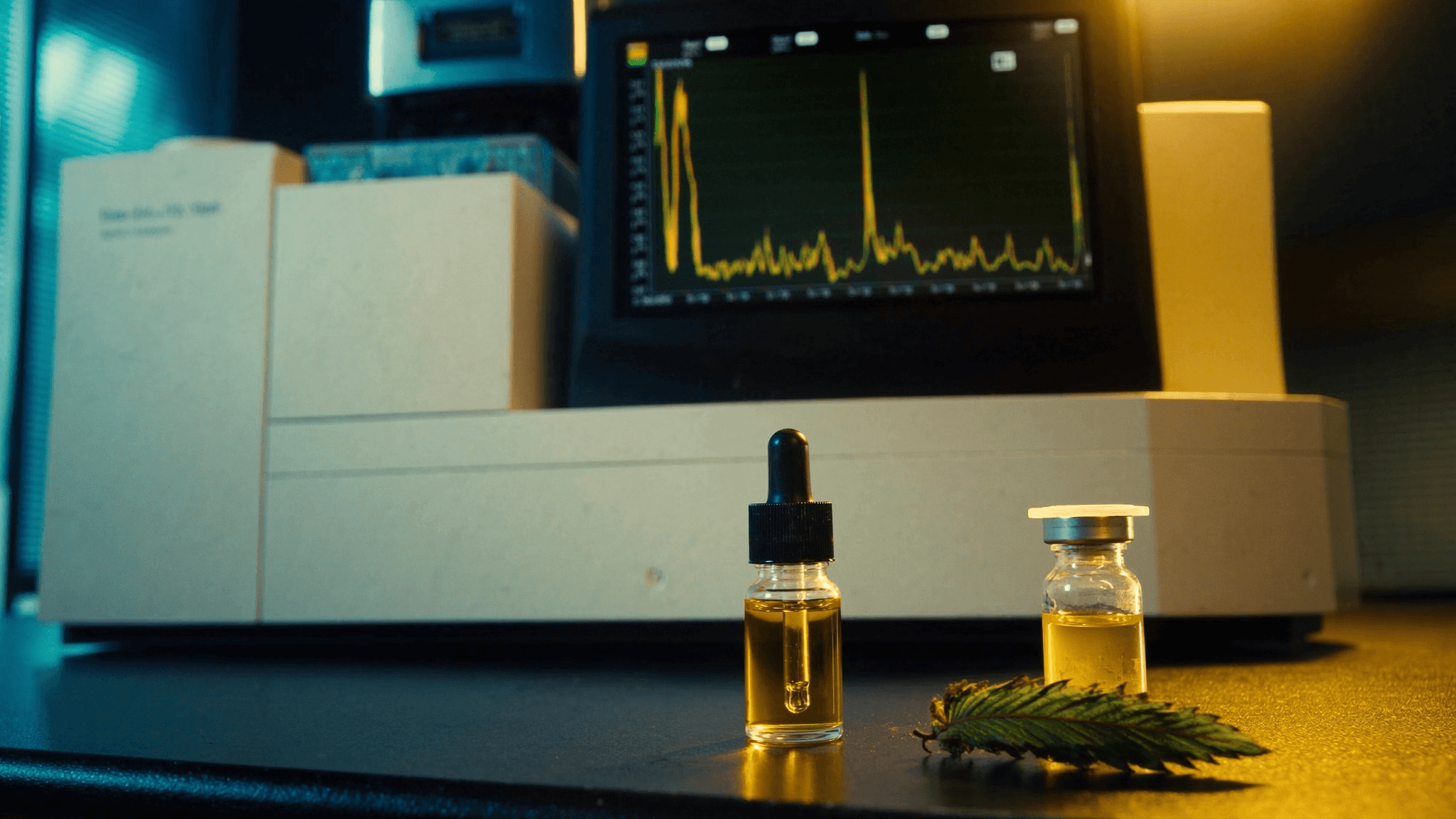
The molecule we identify.
The assays we run on CBD Isolate.
The failure modes we see most.
- 01Purity below 99 %. Material sold as 'isolate' but measuring 95-98 % is actually distillate or broad-spectrum, not true isolate. The 16-cannabinoid scan shows higher minor-cannabinoid content than expected.
- 02Δ⁹-THC above 0.3 %. The Farm Bill compliance line. True isolate should be at or near detection limit; even 0.1 % Δ⁹-THC suggests inadequate post-extraction purification.
- 03Heavy metals from cultivation soil that survived extraction. ICP-MS Pb / Cd in particular fail USP <232> in maybe 5 % of submissions.
- 04Pesticide carryover. Less common with isolate (vs full-spectrum) but still appears in 5-10 % of submissions. Imported hemp material has higher pesticide-fail rates than US-grown.
- 05Mycotoxin contamination from improperly-cured starting material. Aflatoxin B1 / ochratoxin appear in 3-5 % of submissions, especially on imported hemp crude.
Transparent panels for CBD Isolate.
HPLC purity + Δ⁹-THC attestation + 16-cannabinoid scan. The compliance receipt.
- HPLC purity %
- Δ⁹-THC compliance attestation
- 16-cannabinoid scan
- Signed analyst attestation
- Public COA + accession #
- 5-6 day turnaround
Purity + THC + ICP-MS heavy metals + microbial. The broker / carrier COA.
- Everything in Purity + THC
- ICP-MS heavy metals (4-panel)
- USP <232> PDE reporting
- Microbial limits (USP <61/62>)
- Conformity Testing +1
- 7-9 day turnaround
Plus 66-analyte pesticide + mycotoxin panels. The 2018 Farm Bill compliance package.
- Everything in Retail Ready
- 66-analyte pesticide screen
- Aflatoxin + ochratoxin
- Karl Fischer moisture
- Loss on drying
- Conformity Testing +1
- 8-10 day turnaround
CBD Isolate testing — the common questions.
What's the difference between CBD isolate and CBD distillate?+
Isolate is single-cannabinoid CBD at ≥ 99 % HPLC purity — crystalline material with minimal minor cannabinoids or terpenes. Distillate (sometimes called 'broad spectrum' or 'full spectrum') has CBD as the major component but retains a measurable fraction of minor cannabinoids (CBG, CBN, CBC, occasionally Δ⁹-THC). The 16-cannabinoid scan confirms which product is in the vial: isolate shows < 0.5 % combined minor cannabinoids; distillate shows 5-20 %.
How is the Δ⁹-THC attestation calculated?+
Per the 2018 Farm Bill, total THC = `(THCA × 0.877) + Δ⁹-THC`, where the 0.877 factor accounts for the mass loss when THCA decarboxylates to Δ⁹-THC. The result is reported as % dry weight against the 0.3 % ceiling. For true isolate, both THCA and Δ⁹-THC should be at or near detection limit — total THC effectively zero. Signed analyst attestation is included on every COA for broker / carrier / transport audit purposes.
What sample size do you need?+
Crystalline isolate: 1 g (one retail unit). Liquid distillate: 5 g. Capsules: 10 capsules. Ship at ambient temperature; CBD is stable at room temperature for the analysis window. Include lot and batch labeling on the original packaging — chain of custody starts with the seal-integrity check at sample receipt.
Do you do COA work for brokers / carriers shipping interstate?+
Yes — that's the Retail Ready ($329) panel use case. The signed Δ⁹-THC attestation is the document carriers and brokers ask for. We include explicit language tying the result to the 2018 Farm Bill compliance line plus the analyst's signature.
How does this compare to other CBD-isolate testing labs?+
Our Retail Ready panel at $329 covers HPLC + 16-cannabinoid + Δ⁹-THC + ICP-MS heavy metals + microbial on a single COA. Equivalent scope at competing labs (Eurofins, ProVerde, ACS Laboratory) typically runs $425-$595. Where we differ is the published Δ⁹-THC compliance attestation — most labs report Δ⁹-THC as a number but don't add the explicit Farm Bill compliance language brokers want.
Other cannabinoid · cbd testing —
Full CBD menu — broad / full-spectrum testing, cannabinoid profile, pesticide / mycotoxin.
Kratom alkaloid quantification — botanical sibling category with similar Farm Bill / AKA-GMP dynamics.
Once CBD isolate goes into a finished supplement (gummies, capsules), label-claim verification kicks in.
Verify the isolate. Sign the COA.
HPLC purity, Δ⁹-THC attestation, heavy metals — Houston bench, public COA, transparent pricing.