

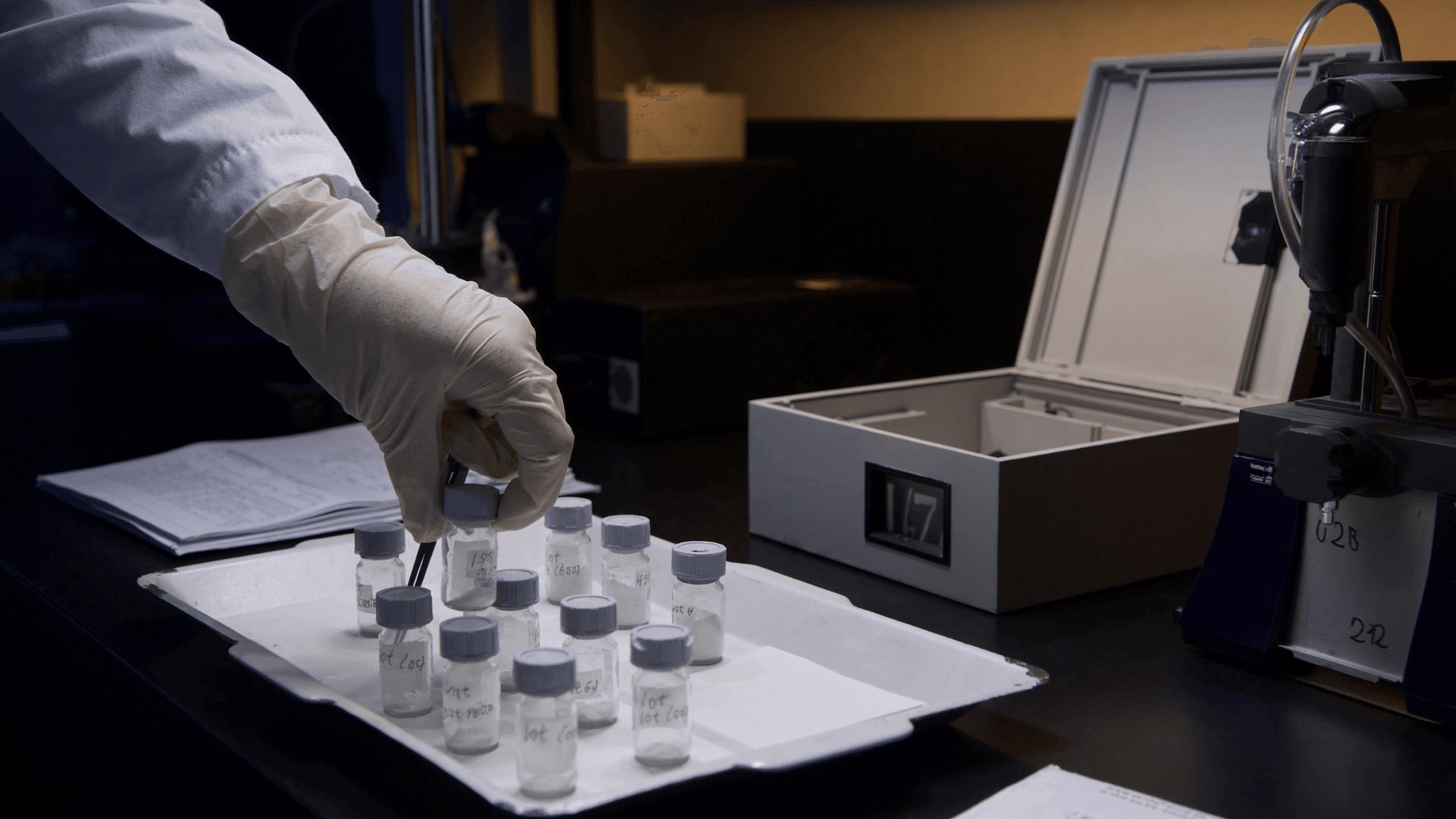
The molecule we identify.
The assays we run on Retatrutide.
The failure modes we see most.
- 01Sequence ambiguity. Several Retatrutide analogs (LY3437943 variants) circulate in research-peptide catalogs under similar names. LC-MS confirms which specific molecule is in the vial.
- 02Truncations from the 39-residue synthesis. Look for related-impurity peaks at RT - 0.6 to RT - 1.5 min. Public HPLC-only COAs often miss these.
- 03Net Peptide Content variability. Research-grade Retatrutide spans 65-86 % NPC depending on vendor and lyophilization quality. Always test NPC if dose accuracy matters.
- 04TFA residual above 5 %. Adds significant mass that mis-counts as active peptide; also causes injection-site stinging.
- 05Lyophilization moisture creep. Triple-agonist molecules are hygroscopic; vials opened in humid environments gain water mass within hours.
Transparent panels for Retatrutide.
Identity (LC-MS) + HPLC purity % + Net Peptide Content. Baseline COA — public + accession #.
- Identity (LC-MS/MS)
- HPLC purity % + impurity peaks
- Net Peptide Content
- Public COA + accession #
- 5-7 day turnaround
COA Essentials plus USP <85> endotoxin (LAL) and USP <71> sterility. The injectable-grade package.
- Everything in COA Essentials
- Endotoxin (LAL) USP <85>
- Sterility USP <71>
- Conformity Testing +1
- 5-7 day turnaround
Plus heavy metals (ICP-MS, USP <232>) and USP <61> bioburden. The full vendor / compounding COA.
- Everything in Injectable Safety
- Heavy metals (ICP-MS) USP <232>
- Bioburden (USP <61>)
- Conformity Testing +1
- 5-7 day turnaround
Retatrutide testing — the common questions.
Is Retatrutide FDA-approved yet?+
No — as of mid-2026, Retatrutide is still in late-stage Eli Lilly clinical trials (Phase 3 for obesity and Type 2 diabetes). All Retatrutide material currently available outside the Lilly clinical-trial supply chain is research-use-only material from compounding pharmacies or research-peptide vendors. Our testing is appropriate for research material — we are not a substitute for FDA-regulated supply-chain controls.
How is Retatrutide different from Semaglutide and Tirzepatide on the analytical side?+
Sequence length and pharmacophore complexity. Semaglutide is single-agonist, ~31 residues. Tirzepatide is dual-agonist, 39 residues with a methionine residue prone to oxidation. Retatrutide is triple-agonist, 39 residues with a more complex modified side chain. From an HPLC + MS perspective the methods are identical; what changes is the impurity profile — Retatrutide has the most truncation peaks because of the longer / more-modified synthesis. We tune the HPLC gradient specifically to resolve those near-main-peak related substances.
What's a 'good' Net Peptide Content for research-grade Retatrutide?+
We see 65-86 % NPC across research-peptide-vendor Retatrutide submissions, with a median around 78 %. Above 82 % is good quality. Below 70 % usually indicates excess counter-ion or residual lyophilization water — the vial labeled '10 mg' really only has ~6.8 mg of active. The NPC is independent of HPLC purity — a vial can be 99 % HPLC purity and only 72 % NPC.
Can you confirm Retatrutide vs another triple-agonist analog?+
Yes by LC-MS. The molecular ion mass and charge-state envelope are specific to the published Retatrutide structure; substitutions, deletions, or unrelated tri-agonist analogs have different observed masses. LC-MS identity is folded into every peptide COA — COA Essentials ($289) and above — so we catch this on any panel. For ambiguous cases we'll add MS/MS fragment-ion analysis at no charge.
Is sterility testing meaningful for research-only material?+
Legally not required for research material, but the USP <71> sterility test is what separates injectable-grade from research powder. Most Retatrutide research material is reconstituted and injected — sterility matters in practice even if the regulatory label says 'research use only'. The 14-day culture method is included in Vendor Full QC ($849).
How much Retatrutide do you need?+
COA Essentials ($289): single 2 mg sealed lyophilized vial. Injectable Safety ($599): same single vial — we re-use dissolved material across HPLC, LC-MS, NPC, and TFA assays. Vendor Full QC ($849): two additional vials for the destructive sterility and endotoxin tests. Ship by overnight courier with seal-integrity-intact packaging.
Other triple glp-1 / gip / glucagon agonist testing —
Verify the vial. Sign the COA.
HPLC purity, LC-MS identity, NPC, TFA, endotoxin, sterility — Houston bench, public COA, transparent pricing.