
HPLC and LC-MS/MS testing
We run reversed-phase HPLC-UV for purity and content and triple-quadrupole LC-MS/MS for identity, on peptides, supplements, raw materials and cosmetics. Results come on a certificate with the chromatogram, method and instrument printed.
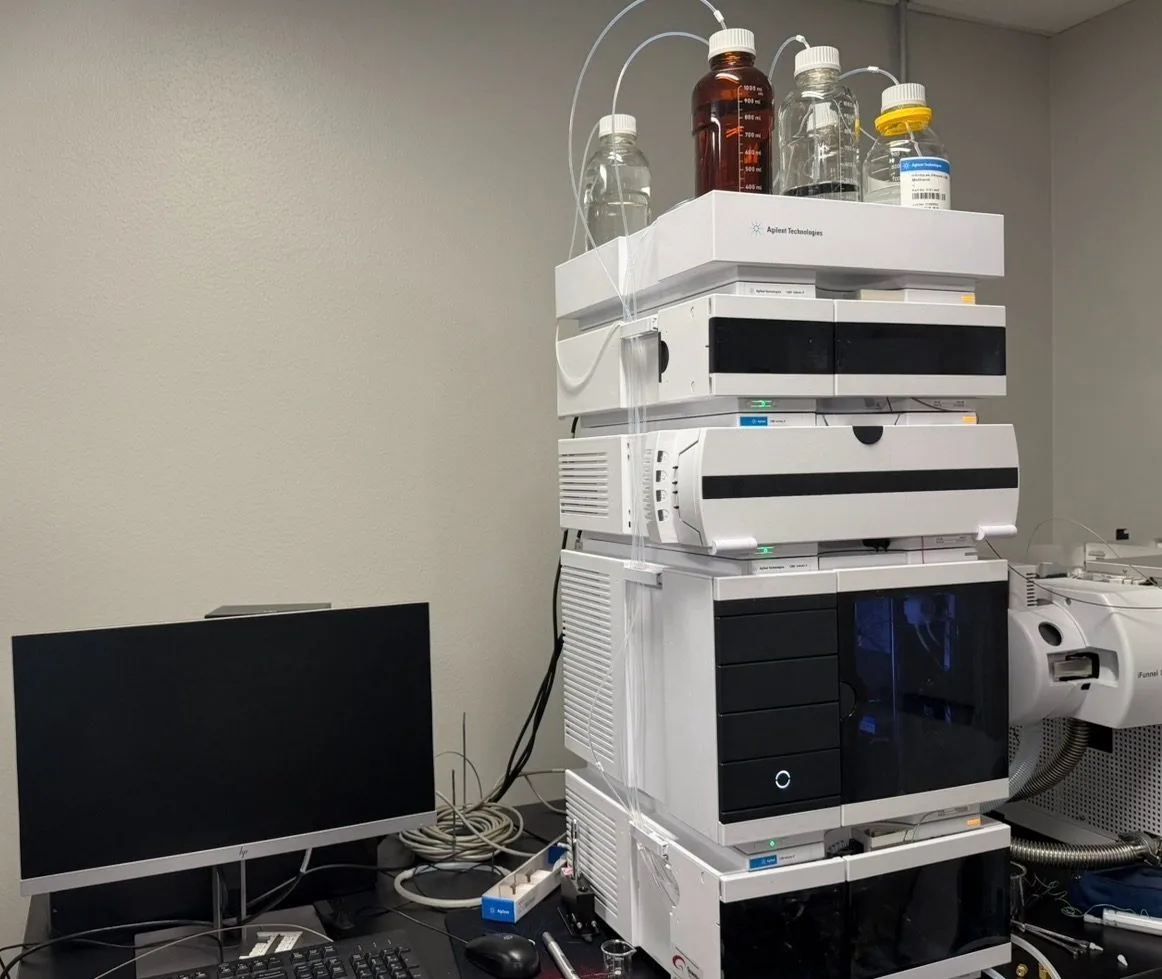
The instruments
| Instrument | Used for | Reports |
|---|---|---|
| Agilent 1290 Infinity II UHPLC | Used forPurity by area percent at 214 nm; content against a certified reference standard | ReportsChromatogram, area %, mg per unit and % of label claim |
| Agilent 6490 triple quadrupole LC/MS | Used forIdentity by electrospray LC-MS/MS: charge-state m/z and MRM transitions | ReportsObserved vs theoretical mass, ±0.1 Da; pass or fail |
The instrument ID, column lot and standard lot are printed on each certificate.
What we test by HPLC
Peptides
Purity at 214 nm, identity by LC-MS/MS and net peptide content, from $189.
Raw materials and APIs
Identity and assay of incoming ingredients against a reference standard.
HPLC, UHPLC and LC-MS compared
| HPLC-UV | UHPLC-UV | LC-MS/MS | |
|---|---|---|---|
| Measures | HPLC-UVAmount of each separated component | UHPLC-UVSame, with sharper peaks | LC-MS/MSMolecular mass and fragments |
| Answers | HPLC-UVPurity, content | UHPLC-UVPurity, content | LC-MS/MSIdentity, trace impurities |
| Typical use here | HPLC-UV | UHPLC-UVPeptide purity and content | LC-MS/MSPeptide identity, counter-ions |
How to read HPLC results
A chromatogram plots detector response against time. Each peak is a component leaving the column; its retention time is when it leaves, and its area is proportional to how much of it there is at that wavelength.
Purity by area percent divides the main peak's area by the total area of all integrated peaks. For example, a main peak of 9,800 mAU·s with impurity peaks of 120 and 80 mAU·s gives 9,800 ÷ 10,000 × 100 = 98.0%.
Retention time alone does not identify a compound: two different molecules can leave the column at nearly the same time. That is why we confirm identity by mass on the LC-MS/MS.
How a purity result is produced
The sample is dissolved and injected onto a sub-2 µm C18 column and eluted with a water and acetonitrile gradient containing 0.1% trifluoroacetic acid. The UV detector reads 214 nm, where peptide bonds absorb. Integration follows a written procedure, and the certificate prints the chromatogram so anyone can see the peaks behind the number.
Read more in peptide purity explained and DAD vs VWD detectors.
HPLC testing questions
What is HPLC testing?
High-performance liquid chromatography separates a sample into its components on a packed column and measures each one as it leaves. It is used to measure purity, to quantify an active ingredient against a reference standard and to find impurities.
What is the difference between HPLC and LC-MS?
HPLC with a UV detector measures how much of each separated component there is. LC-MS adds a mass spectrometer that measures each component's molecular mass, which identifies it. We use HPLC-UV for purity and content, and LC-MS/MS for identity.
How much does HPLC testing cost?
Peptide identity and purity together cost $189 ($289 for GLP-1 class peptides). Other sample types are priced on their service pages and itemized in sample intake before you pay.
What sample do I need to send?
For peptides, one sealed vial per test, as sold. For supplements and other products, the intake lists the amount for each assay. Write only the lot on the container.
What is a C18 column?
A column packed with silica particles bonded to 18-carbon chains. Peptides stick to it in proportion to how water-repellent they are, and a rising acetonitrile gradient releases them one by one. It is the standard column for peptide purity.
Why is peptide purity measured at 214 nm?
Peptide bonds absorb ultraviolet light strongly around 214 nm, so nearly every peptide-like component shows up. Wavelengths such as 280 nm only see peptides that contain tryptophan or tyrosine.
Is UPLC the same as HPLC?
UPLC (or UHPLC) is HPLC run at higher pressure on columns with smaller particles, which gives sharper peaks in less time. Our Agilent 1290 Infinity II is a UHPLC system.