
Peptide purity: what the percentage means and how it is measured
Every research peptide is sold with a purity figure, usually 98% or 99%. Here is what that number measures, what it leaves out, and how to read it on a certificate of analysis.
From the analysts at Gold Standard Analytics, Houston. Updated October 27, 2026.
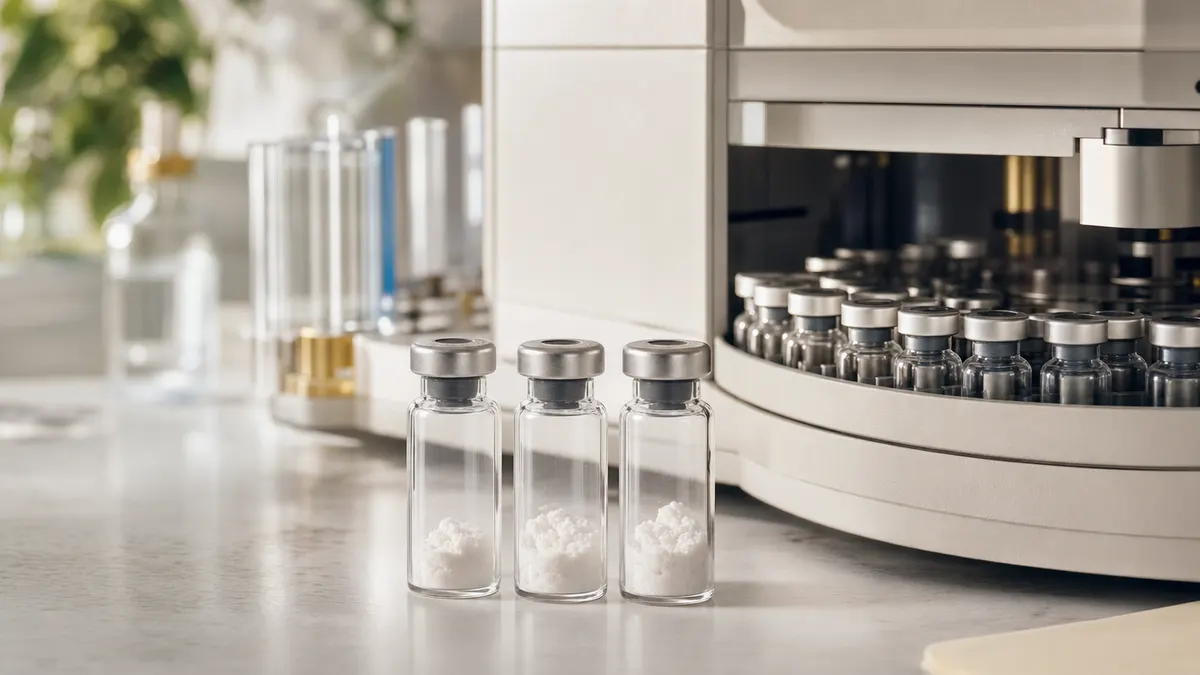
How HPLC measures purity
A small amount of the peptide is dissolved and injected onto a reversed-phase C18 column. A gradient of water and acetonitrile with 0.1% trifluoroacetic acid carries each component through the column at its own speed, and a UV detector records absorbance as the components leave.
Peptide bonds absorb strongly at 214 nm, so almost every peptide-like component shows up as a peak. The software integrates the area under each peak. Purity is the main peak's area divided by the total area of all integrated peaks, times 100.
What purity does not tell you
| Question | Test that answers it | Why purity cannot |
|---|---|---|
| Is it the right peptide? | Test that answers itIdentity by LC-MS/MS | Why purity cannotA wrong or modified peptide can still give one clean peak; only its mass shows what it is. |
| How much peptide is in the vial? | Test that answers itNet peptide content against a certified reference standard | Why purity cannotPurity is a ratio. A 99% pure vial labelled 5 mg can hold far less than 5 mg of peptide. |
| Is it contaminated with bacterial endotoxin? | Test that answers itUSP <85> endotoxin | Why purity cannotEndotoxin is invisible to UV detection at these levels. |
| Is it sterile? | Test that answers itUSP <71> sterility | Why purity cannotLive organisms do not appear in a chromatogram. |
| Does it contain heavy metals? | Test that answers itICP-MS to USP <232>/<233> | Why purity cannotMetals are not detected by UV. |
Purity versus net peptide content
Lyophilised peptide powder is never 100% peptide. Counter-ions left from synthesis (trifluoroacetate or acetate), bound water and bulking agents such as mannitol add weight. Net peptide content measures the peptide itself: we weigh the vial, reconstitute a known volume and quantify against a certified reference standard, then report milligrams per vial and percent of the label claim.
That is why a vial can be 99% pure and still hold well under its labelled amount. If you are comparing a vial with its label, net peptide content is the number to read.
| Purity (HPLC area %) | Net peptide content | |
|---|---|---|
| Answers | Purity (HPLC area %)How clean is the peptide material? | Net peptide contentHow many milligrams of peptide are in the vial? |
| Reported as | Purity (HPLC area %)% of total peak area at a stated wavelength | Net peptide contentmg per vial and % of label claim |
| Needs a reference standard | Purity (HPLC area %)No | Net peptide contentYes |
| Can exceed 100% | Purity (HPLC area %)No | Net peptide contentYes, when a vial is overfilled |
What purity level is good enough?
| HPLC purity | What it usually means |
|---|---|
| 99% and above | What it usually meansA very clean sample at the stated wavelength. Still confirm identity and net content. |
| 98% to 99% | What it usually meansThe specification most research suppliers advertise. A clean result if identity passes. |
| 95% to 98% | What it usually meansAcceptable for many research uses; look at what the impurity peaks are. |
| Below 95% | What it usually meansA meaningful share of something else: degradation, synthesis leftovers or a different peptide. Ask what the other peaks are. |
General guide for research peptides. Pharmaceutical specifications also limit each individual impurity, not only the total.
Comparing purity results between labs
- Test the same lot. Different lots of the same product can differ by several points.
- Check the wavelength: 214 nm and 220 nm see peptides differently from 254 or 280 nm.
- Look at the date: reconstituted peptides and warm shipments degrade, and purity falls with them.
- Read the chromatogram, not just the number: a single impurity peak and many small ones can add up to the same total.
Common peptide impurities
- Deletion and truncated sequences: chains missing one or more amino acids, left over from solid-phase synthesis.
- Incomplete deprotection: protecting groups still attached to side chains, which shift the mass.
- Oxidation and deamidation: methionine and tryptophan oxidise; asparagine and glutamine deamidate, especially in solution and with heat.
- Dimers and aggregates: two or more chains joined, common with cysteine-containing peptides.
- Residual TFA: a counter-ion rather than a peptide impurity; it adds weight and is measured separately.
How to read the purity line on a certificate
- 1Find the method: reversed-phase HPLC with UV detection, and the wavelength (214 nm or 220 nm for peptides).
- 2Look for the chromatogram itself. A purity figure without a chromatogram cannot be checked.
- 3Check that identity was tested by mass spectrometry on the same sample, not assumed from retention time.
- 4Match the lot number and the date tested with the vial you have.
- 5Verify the certificate with the laboratory that issued it. GSA certificates can be checked at /verify; see how to read a COA and how to spot a fake.
Test a peptide's purity
Gold Standard Analytics runs HPLC-UV purity at 214 nm on an Agilent 1290 Infinity II together with LC-MS/MS identity on an Agilent 6490 triple quadrupole, from $189 per sample ($289 for GLP-1 class peptides). The certificate prints the chromatogram, method, instrument and column lot. How to get a peptide tested walks through ordering and shipping.
Peptide purity questions
What does 99% peptide purity mean?
It means that 99% of the UV signal in the HPLC chromatogram, at the stated wavelength, belongs to the main peak. It describes how clean the peptide material is. It does not say how many milligrams are in the vial, and on its own it does not prove the main peak is the peptide on the label.
Is 98% purity good for a research peptide?
Research-grade peptides are commonly specified at 95% or 98% and above by HPLC. A 98% result is a clean sample if the identity check also passes and the certificate shows the chromatogram, wavelength and the lab that ran it.
Can purity be higher than 100%?
No. Purity by area percent cannot exceed 100%. Net peptide content, expressed as a percentage of the label claim, can exceed 100% when a vial is overfilled.
Why do two labs report different purity for the same peptide?
Detection wavelength, column chemistry, gradient, integration settings and the age and handling of the sample all move the number. Compare results only when the method details are printed, and test the same lot.
Does a purity test check for endotoxin or bacteria?
No. Purity says nothing about bacterial endotoxin, sterility or heavy metals. Those need their own tests: USP <85> endotoxin, USP <71> sterility and ICP-MS metals.
How much does a peptide purity test cost?
At Gold Standard Analytics, HPLC purity comes with LC-MS/MS identity from $189 ($289 for GLP-1 class peptides). Net peptide content is a $29 add-on. See peptide testing prices.