DAD vs VWD in HPLC: what the detector changes about a purity number
Both detectors measure UV absorbance. One measures it at a single wavelength; the other captures a full spectrum at every point of the chromatogram. That difference decides whether a purity result can tell you what the impurities are.
A variable wavelength detector (VWD) reads absorbance at one wavelength you set before the run. A diode array detector (DAD) records the whole UV-visible spectrum, typically 190 to 640 nm, at every time point. Both produce a chromatogram; only one produces a spectrum for each peak.
Why it matters for peptides
Peptide purity by HPLC is an area-percent calculation: the main peak area divided by the total area of all peaks. If an impurity does not absorb at the wavelength you chose, it is invisible and purity is overstated. With a VWD at 214 nm you cannot know what you missed. With a DAD you can pull the spectrum of every minor peak, confirm it absorbs like a peptide bond, and check whether two peaks that co-elute are actually one compound.
What each detector answers
| Question | VWD | DAD |
|---|---|---|
| Area-percent purity at 214 nm | Yes | Yes |
| Peak purity (is the main peak one compound?) | No | Yes, by spectral comparison across the peak |
| Identify an unexpected peak class | No | Partly, from its UV spectrum |
| Report purity at 220 and 280 nm from the same run | No, one wavelength per run | Yes, any wavelength after the fact |
| Baseline noise at trace level | Slightly lower | Comparable on current hardware |
What we run
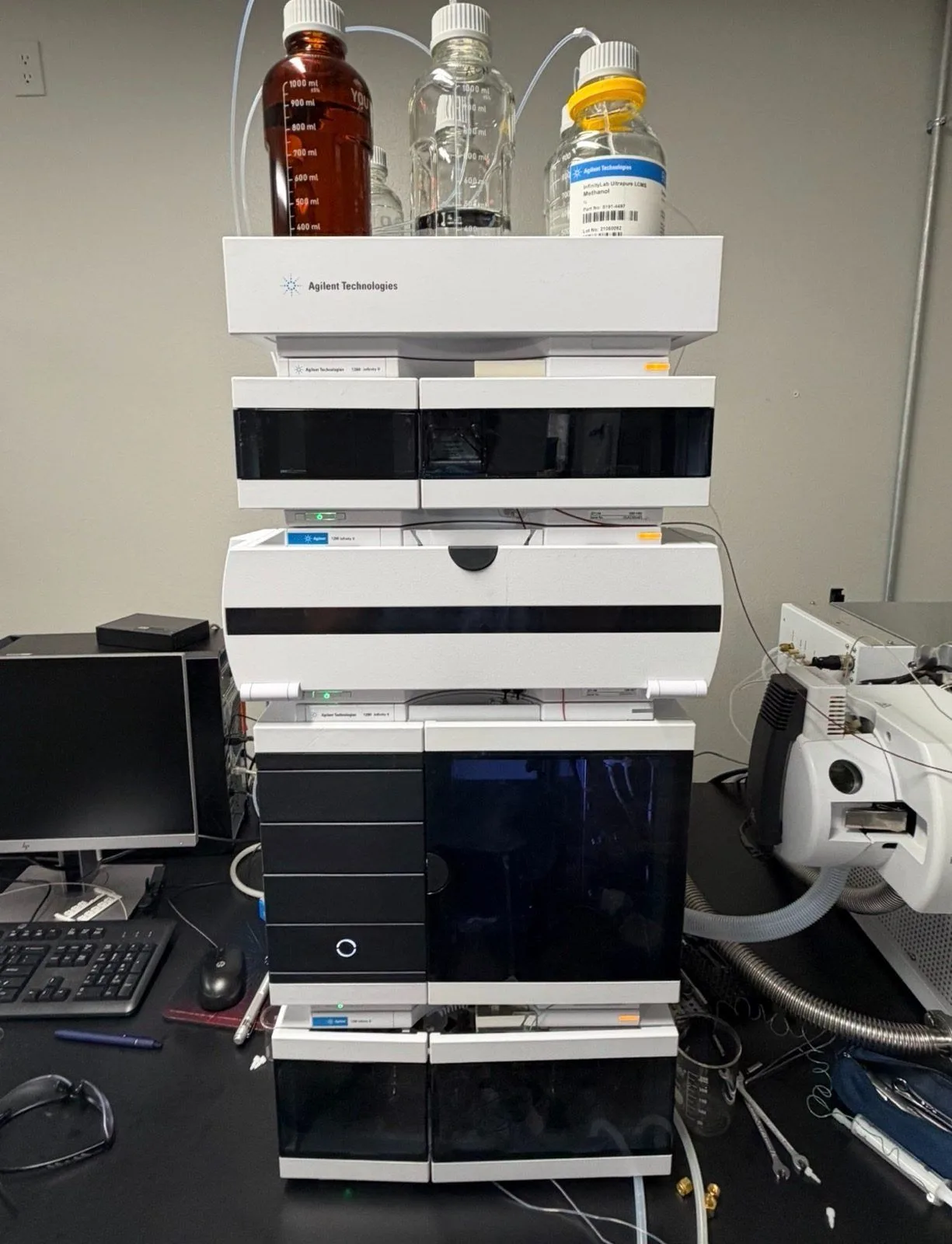
Our Agilent 1290 Infinity II stack carries a DAD. Purity is reported at 214 nm for comparability with the wider industry, and the certificate notes peak-purity confirmation when the spectra across the main peak match within threshold. Where a client specification calls for 220 or 280 nm, the same data file is reprocessed rather than re-injected.
Where VWD is still fine
Routine release of a well-characterized compound with a validated method and a known impurity profile. In that setting the wavelength has already been chosen for the impurities that matter. For a compound you have never tested from a supplier you have never used, a DAD run is the safer first look.