USP <71> sterility vs bioburden: they answer different questions
Sterility testing asks whether any viable organism is present in the units tested. Bioburden counts how many are there. For an injectable, only one of these is the release test.
Both tests grow microorganisms from a sample. The difference is the question, the method and what a result allows you to claim.
USP <71> sterility
A qualitative test. Sample is filtered through a 0.45 µm membrane in a closed system, the membrane is transferred to two media (tryptic soy broth for aerobes and fungi, fluid thioglycollate for anaerobes) and incubated fourteen days. Any growth in any canister is a failure. The result is Sterile or Not sterile for the units tested; the standard also specifies how many units to test based on batch size.
Bioburden, USP <61> and <62>
A quantitative test. Sample is plated or filtered and colonies are counted after incubation, reported as CFU per gram or per unit, with separate enumeration of total aerobic microbial count and total yeast and mould count. USP <62> adds tests for specified organisms such as E. coli, Salmonella, Pseudomonas aeruginosa and Staphylococcus aureus. Bioburden is the right test for non-sterile products: capsules, powders taken orally, topicals, kratom leaf.
| USP <71> sterility | Bioburden USP <61>/<62> | |
|---|---|---|
| Question | Is anything alive in it? | How much is alive in it, and is any of it a specified pathogen? |
| Result | Sterile / Not sterile | CFU/g or CFU/unit, plus presence or absence of specified organisms |
| Incubation | 14 days | 3 to 5 days (bacteria), 5 to 7 days (yeast and mould) |
| Applies to | Injectables, ophthalmics, implants | Oral, topical, botanical and raw material products |
| Destroys the unit | Yes | Yes |
| Can it release an injectable | Yes, with USP <85> endotoxin | No |
Why bioburden cannot stand in for sterility
A low bioburden count on an injectable tells you the batch was clean before the final filter or autoclave cycle. It does not tell you the cycle worked. Sterility testing is the only test that asks the release question directly, and the fourteen-day incubation exists because slow-growing organisms do not show in five.
What we run
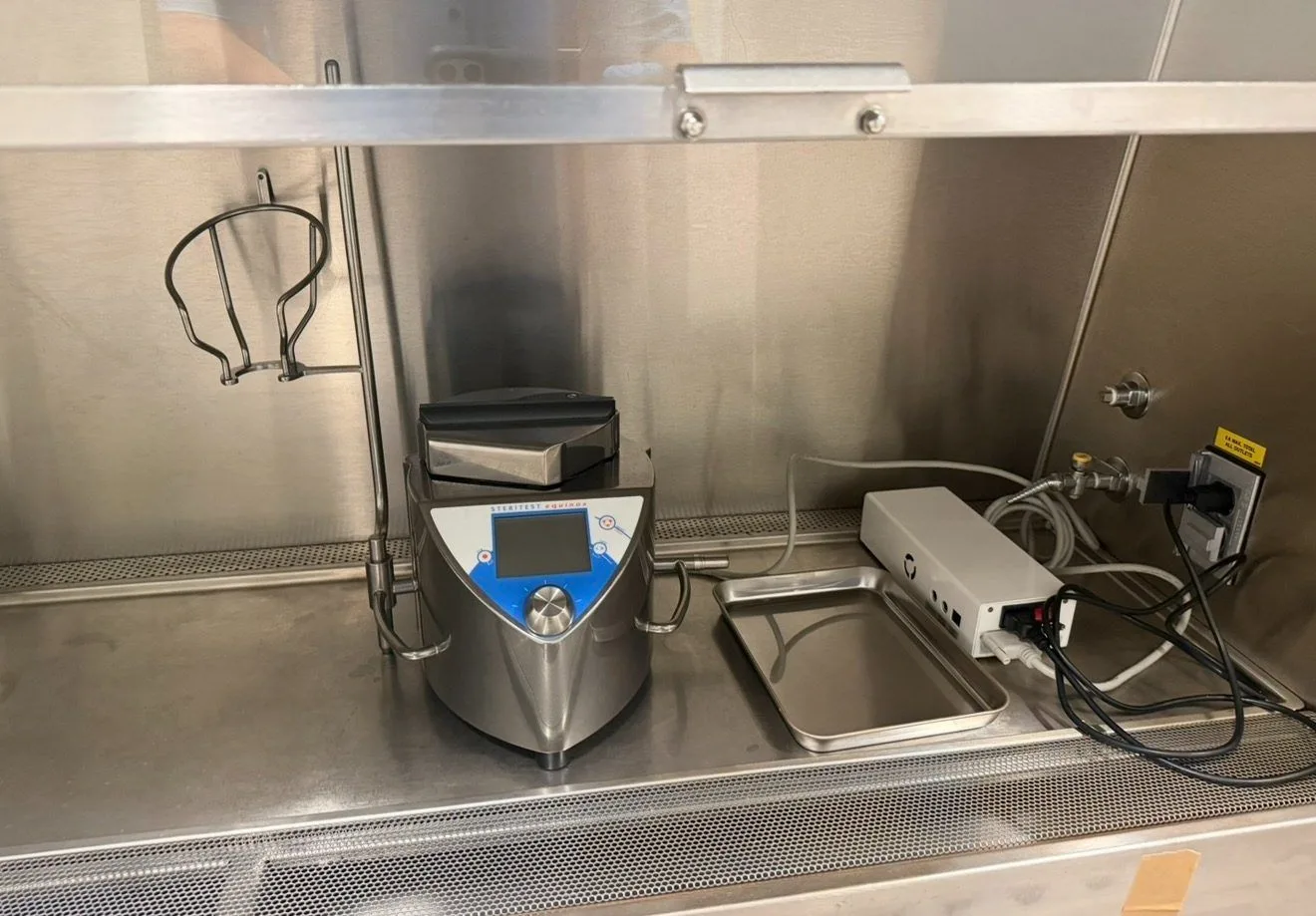
Sterility is performed on two MilliporeSigma Steritest Equinox pumps in a SterilGARD II class II biosafety cabinet, using single-use closed canisters so the membrane is never exposed to room air. Media growth promotion is verified per lot. Bioburden and specified organisms are run in the microbiology suite by membrane filtration or pour plate depending on the matrix. Both require an extra unit beyond the chemistry sample, and sterility adds fourteen days to turnaround.