Hemp cannabinoid potency, total THC and contaminant testing
Buyers read the cannabinoid line on a hemp certificate to decide whether a product is what the label says and whether it sits under the 0.3% total THC line. We report the full profile by HPLC-DAD against an individual certified standard for each cannabinoid, calculate total THC the way the USDA rule defines it, confirm ambiguous isomers by LC-MS/MS, and run the contaminant panels a finished product needs on the same accession. Every certificate is public.
- From
- $79
- Turnaround
- 5–7 business days
- Certificate
- Public, hashed, video-linked
What the panel measures
| Test | Method | Instrument | Reports as |
|---|---|---|---|
| Cannabinoid profile | MethodRP-UHPLC-DAD, one certified reference standard per cannabinoid, 11 to 18 targets | InstrumentAgilent 1290 Infinity II UHPLC | Reports asmg/g or mg/unit and % w/w; total THC and total CBD calculated |
| Total THC | MethodΔ9-THC + 0.877 × THCA, from the profile | InstrumentAgilent 1290 Infinity II UHPLC | Reports as% w/w against the 0.3% hemp limit |
| Isomer confirmation | MethodLC-MS/MS where Δ8, Δ9 and Δ10-THC or CBD and CBG co-elute | InstrumentAgilent 6490 Triple Quadrupole LC/MS | Reports asConfirmed identity of the reported peak |
| Terpenes | MethodCalibrated GC-MS, liquid or headspace injection | InstrumentAgilent GC-MS with headspace | Reports asmg/g, principal terpenes |
| Pesticides | MethodQuEChERS extraction; LC-MS/MS and GC-MS multi-residue, 125 to 370 targets | InstrumentAgilent 6490 Triple Quadrupole LC/MS | Reports asµg/kg against action limits |
| Heavy metals | MethodClosed-vessel digestion, ICP-MS: Pb, As, Cd, Hg | InstrumentAgilent 7850 ICP-MS | Reports asµg/g |
| Residual solvents | MethodHeadspace GC-MS, 24-target panel | InstrumentAgilent GC-MS with headspace | Reports asµg/g against USP <467> limits |
| Mycotoxins | MethodLC-MS/MS: aflatoxins B1, B2, G1, G2 and ochratoxin A | InstrumentAgilent 6490 Triple Quadrupole LC/MS | Reports asµg/kg |
| Microbiology | MethodAPC, yeast and mould, Enterobacteriaceae, E. coli, Salmonella; Aspergillus by qPCR | InstrumentMicrobiology suite | Reports asCFU/g and presence or absence |
Accepted: Flower and biomass, 10 g Extracts and distillates, 2 g Tinctures, one 30 mL unit Gummies and edibles, ten units Topicals, 10 g
Compounds: CBD CBDA Δ9-THC THCA Δ8-THC CBG CBGA CBN CBC THCV CBDV
Sample requirements and shipping
What to send, how to pack it, and what the intake team records when it arrives.
- 1Flower and biomass: 10 g, in a sealed bag. Extracts, distillates and isolates: 2 g in the original container. Tinctures: one unopened 30 mL unit. Gummies and edibles: ten units. Topicals: 10 g.
- 2Add material for each contaminant panel; pesticides and microbiology each consume sample. The intake builder totals the grams.
- 3Ship at room temperature on the prepaid UPS Ground label. Keep products in their original retail packaging; it is photographed at intake and forms part of the record.
- 4We accept lawful hemp only: material you have reason to believe is at or under 0.3% total THC. Material that tests above the limit is destroyed under our SOP and cannot be returned.
- 5Mark the lot on the package and nothing else. The bench sees a blind code.
Hemp testing prices
Tests
| Test | Category | Price |
|---|---|---|
| cannabinoid profile - plant and extract | CategoryPotency | Price$79 |
| cannabinoid profile - finished products | CategoryPotency | Price$119 |
| extended natural cannabinoid profile - 18 targets | CategoryPotency | Price$159 |
| High-purity CBD or CBG isolate assay | CategoryPotency | Price$199 |
| terpene profile | CategoryTerpenes | Price$79 |
| pesticide panel - plant and extract | CategoryPesticides | Price$269 |
| expanded pesticide panel - 125 targets | CategoryPesticides | Price$309 |
| broad pesticide screen - 370 targets | CategoryPesticides | Price$949 |
| residual-solvent panel - 24 targets | CategoryResidual solvents | Price$99 |
| four-metal panel | CategoryMetals | Price$149 |
| mycotoxin panel - five targets | CategoryMycotoxins | Price$69 |
| basic microbiology panel | CategoryMicrobiology | Price$89 |
| expanded microbiology panel | CategoryMicrobiology | Price$179 |
| Aspergillus screen | CategoryMicrobiology | Price$79 |
| water activity | CategoryPhysical quality | Price$29 |
| Vitamin E acetate screen in eligible hemp oil | CategoryAdulterants | Price$69 |
Packages
| Package | Includes | Price |
|---|---|---|
| plant quality package | Includescannabinoid profile - plant and extract, pesticide panel - plant and extract, four-metal panel, mycotoxin panel - five targets, expanded microbiology panel, water activity, loss on drying | Price$649 |
| extract quality package | Includescannabinoid profile - plant and extract, pesticide panel - plant and extract, residual-solvent panel - 24 targets, four-metal panel, mycotoxin panel - five targets, expanded microbiology panel | Price$679 |
| finished-product quality package | Includescannabinoid profile - finished products, pesticide panel - complex finished matrix, residual-solvent panel - 24 targets, four-metal panel, mycotoxin panel - five targets, expanded microbiology panel | Price$819 |
Per sample. Packages bundle the tests a plant, extract or finished product needs for one lot. Expedited turnaround adds 100%, priority 200%.
Why the method matters
One certified standard per cannabinoid
Each cannabinoid is calibrated against its own certified reference standard. Calibrating THCA or CBG off a CBD curve, which some laboratories do to save on standards, biases the result and is one reason the same product reads differently across labs.
Total THC calculated as the rule defines it
Total THC is Δ9-THC plus 0.877 times THCA, the decarboxylation factor in the USDA hemp rule. Both raw values and the calculation are printed on the certificate so a buyer can check the arithmetic.
Isomers confirmed by mass spectrometry
Δ8-THC, Δ9-THC and Δ10-THC, and CBD and CBG, can co-elute on a short UV method. Where a profile shows an ambiguous peak we confirm it by LC-MS/MS on the Agilent 6490 rather than report a guess.
Authentic Agilent bench, OEM consumables
The 1290 Infinity II, 6490 and 7850 were bought new through authorized channels, qualified by Agilent engineers and run on OEM columns and parts. Instrument IDs are printed on every certificate.
How each result is produced
Cannabinoid profile and total THC
Flower is homogenised and extracted in methanol; extracts and finished products are dissolved or extracted according to the matrix. The extract is injected onto an Agilent 1290 Infinity II with a diode array detector and each cannabinoid is quantified against its own certified reference standard. Acidic and neutral forms are reported separately, then total THC and total CBD are calculated with the 0.877 decarboxylation factor and printed with the arithmetic shown.
Contaminants
Pesticides are extracted by QuEChERS and screened by LC-MS/MS on the Agilent 6490 and by GC-MS for the compounds that need it. Heavy metals are digested in closed vessels and read by ICP-MS on the Agilent 7850. Residual solvents run by headspace GC-MS against the USP <467> list. Mycotoxins run by LC-MS/MS. Microbiology enumerates viable counts by culture and screens Salmonella and Aspergillus by PCR.
What the certificate shows
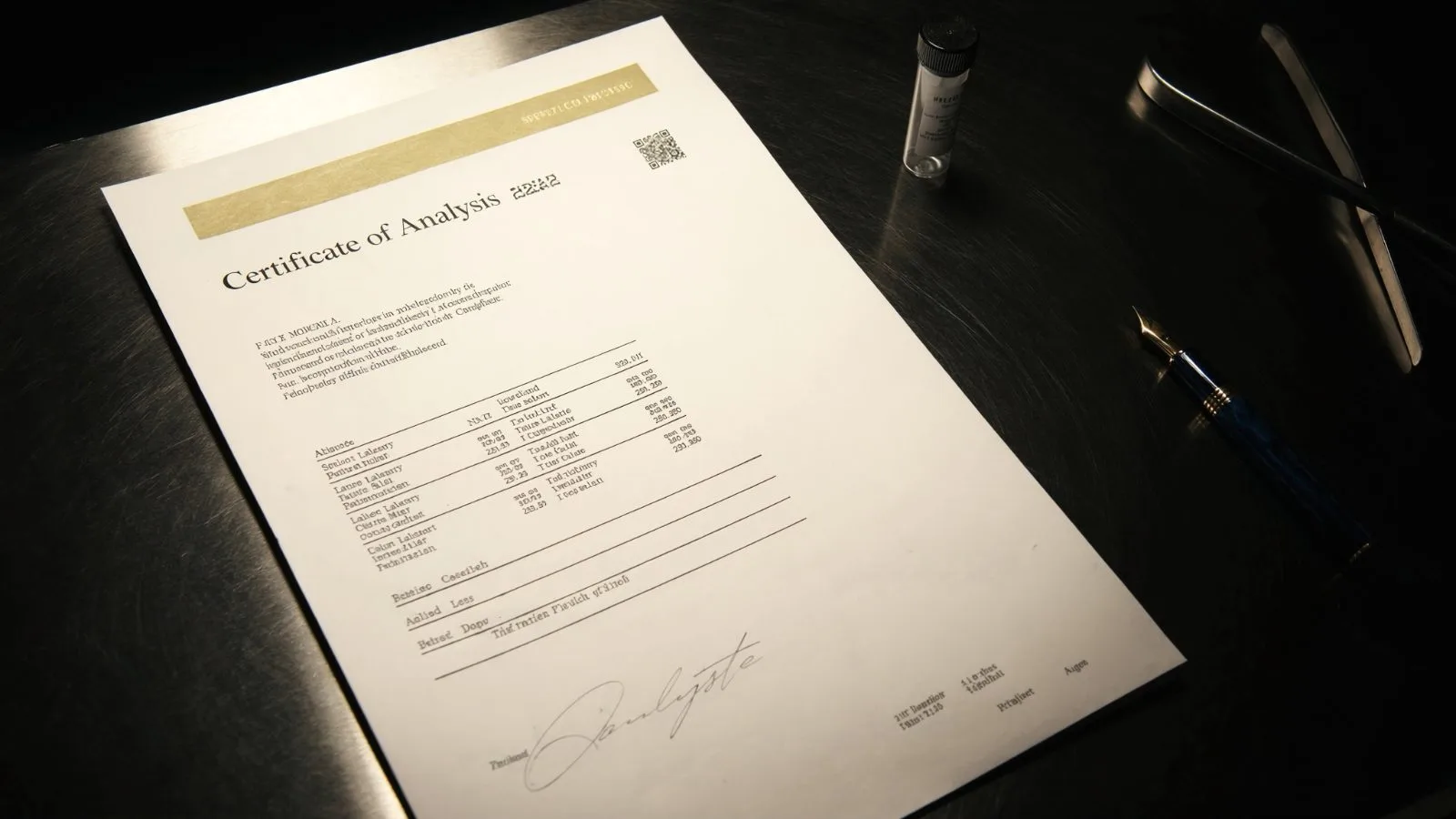
Each line names the analyte, method, instrument ID, result, limit and verdict. The chromatogram for the potency assay is printed. The certificate is public by accession number, carries a SHA-256 hash of the signed file, and links to the intake video and photographs of your package.

The bench this runs on
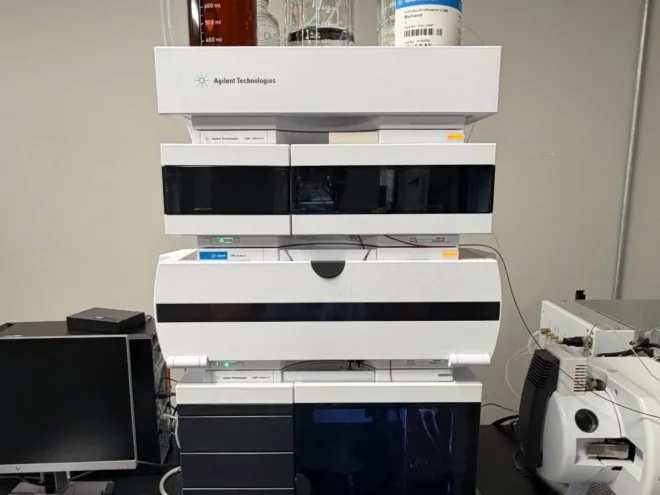
Agilent 1290 Infinity II UHPLC
Purity and potency by UV; 1300 bar, sub-2 µm columns, chromatogram printed on the certificate.
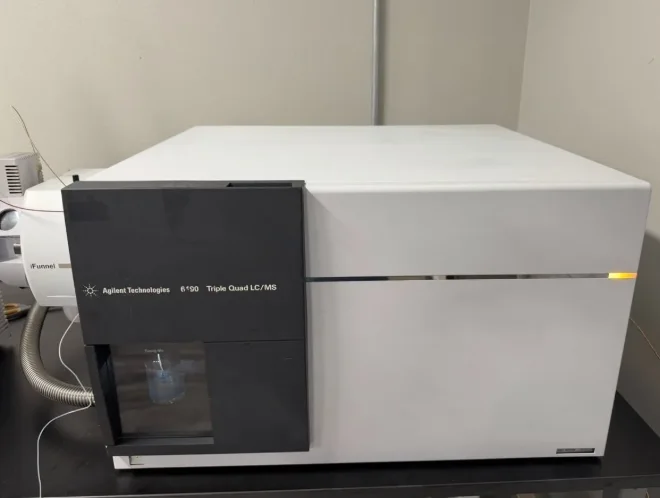
Agilent 6490 Triple Quadrupole LC/MS
Identity by accurate mass and MRM transitions; sub-ppt quantitation with isotope dilution.
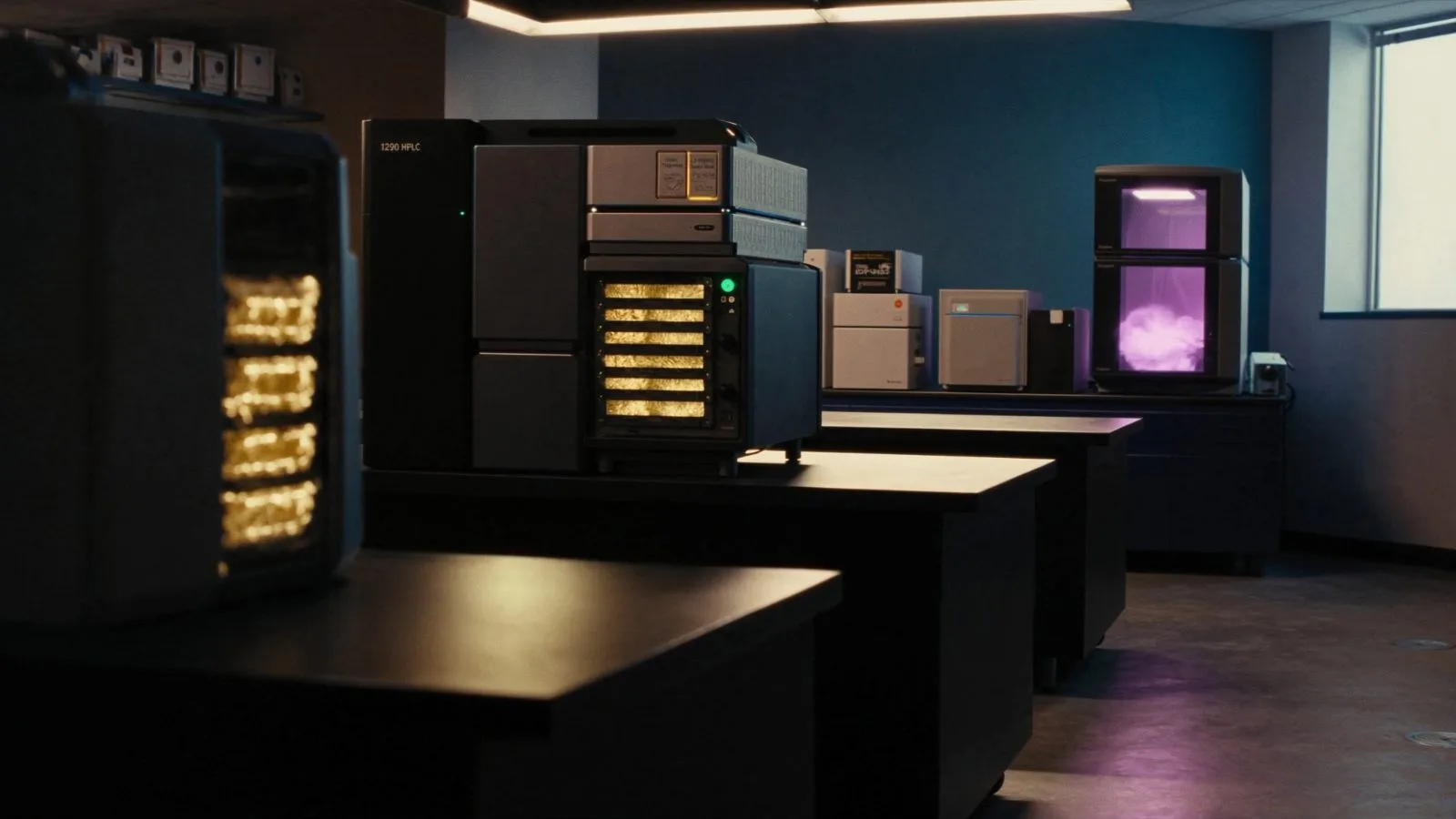
Agilent GC-MS with headspace
Volatiles, residual solvents, BTEX and semivolatiles by EI mass spectrometry.
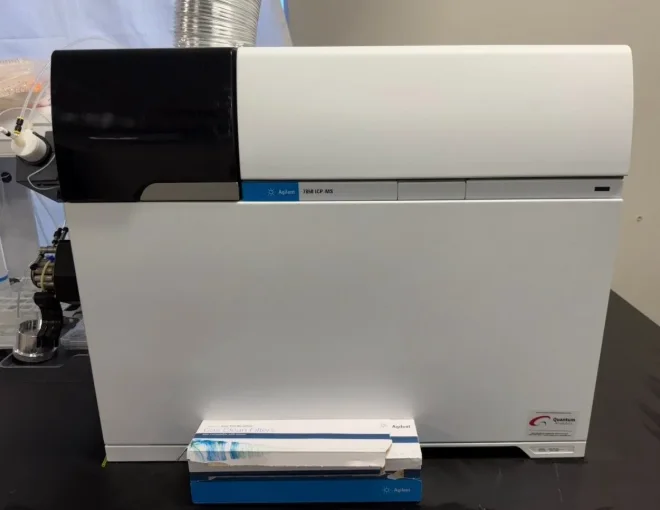
Agilent 7850 ICP-MS
Elemental impurities and toxic metals to sub-ppb, internal-standardized.
Microbiology suite
USP <61>/<62> counts and specified organisms; USP <51> challenge.
Purchased new through authorized channels, installed and performance-qualified by certified engineers, run on OEM consumables. Instrument IDs are printed on every certificate. See the full bench.
Compared with typical cannabis testing laboratories
| Gold Standard Analytics | Typical | |
|---|---|---|
| Public certificate by accession | Gold Standard AnalyticsEvery certificate, searchable and hashed | TypicalUsually a PDF the brand chooses to share |
| Calibration | Gold Standard AnalyticsOne certified standard per cannabinoid | TypicalOften a subset of standards, the rest calculated |
| Isomer confirmation | Gold Standard AnalyticsLC-MS/MS on ambiguous peaks | TypicalUV only |
| Custody video | Gold Standard AnalyticsEvery package opened on camera; footage kept three years | TypicalNot offered |
| Failures published | Gold Standard AnalyticsYes, immutable once signed | TypicalThe brand decides |
| Price from | Gold Standard Analytics$79 potency; $649 plant quality package | TypicalTypical published menus: $50–150 potency; $500–1,000 full panel |
Named, sourced comparisons with individual laboratories are on the compare page.
Questions about hemp testing
Can I see the video of my sample being opened?
Yes. Every package is opened on camera, each container is photographed, and the footage is linked to your accession. Custody video and photos are kept for three years; the retained sample itself is kept 90 days for guarantee retests.
What happens if my result fails?
It is published like any other result, with the method, instrument and specification shown. You may order a retest of the retained sample; we never re-run to obtain a better number.
Does your certificate satisfy state compliance testing rules?
Rules vary by state, and several, including Texas, require the testing laboratory to hold ISO/IEC 17025 accreditation for compliance testing of consumable hemp. We operate to 17025 expectations and are not accredited. Use our certificates for product quality, purchasing decisions and label verification, and check your state’s requirement before relying on any laboratory for compliance testing.
Can you do USDA pre-harvest compliance testing?
No. Pre-harvest compliance testing under the USDA hemp rule must be performed by a DEA-registered laboratory, and we hold no DEA registration. We test harvested hemp, extracts and finished products for potency, quality and contaminants.
What happens if a sample tests above 0.3% total THC?
The result is reported and published like any other. Because we hold no DEA registration, material that exceeds the hemp limit cannot be returned; it is destroyed under our SOP and the destruction is recorded on the accession.
How much material do you need?
Flower and biomass: 10 g. Extracts, distillates and isolates: 2 g. Tinctures: one 30 mL unit. Gummies and edibles: ten units. Add material for each contaminant panel; the intake builder totals it.
Do you test delta-8, HHC and THCA products?
We quantify them. Whether a product is lawful to sell depends on your state, and several states treat intoxicating hemp derivatives as controlled substances. We test lawful material and publish what it contains; we do not give legal advice.
Can the certificate go on my product page automatically?
Yes. Every certificate has a public URL and QR code, the WooCommerce plugin publishes new certificates to the matching product, and the API returns them as JSON.
Method references: USDA Domestic Hemp Production Program, 7 CFR Part 990 · Texas DSHS Consumable Hemp Program · USP <467> Residual Solvents
Other services
Peptides testing · SARMs testing · Kratom testing · Supplements testing · Cosmetics testing · Raw materials testing · Hydrocarbons testing · Pesticides testing · Water and food testing · Compare labs · Laboratory notes
Submit a sample
An invoice is issued at submission and the prepaid label is emailed when payment lands. Certificates publish in 5–7 business days.