Why endotoxin is tested by kinetic chromogenic LAL, and what a PPC is
Endotoxin is the cell-wall fragment of gram-negative bacteria that causes fever in an injection even when nothing is alive. USP <85> sets the test; the positive product control is the part that proves the test worked in your sample.
A sample can pass sterility and still cause a pyrogenic reaction, because endotoxin is a lipopolysaccharide left behind by bacteria that are no longer alive. Autoclaving kills organisms; it does not remove endotoxin. That is why USP <85> is a separate release test for anything injected.
The LAL reaction
Limulus amebocyte lysate, derived from horseshoe crab blood, clots in the presence of endotoxin. Kinetic chromogenic assays measure how fast a colour develops as the reaction proceeds; faster onset means more endotoxin. The result is read against a standard curve and reported in endotoxin units per millilitre or per milligram.
Positive product control
Every sample is run twice: once as-is and once spiked with a known quantity of endotoxin. If the spiked recovery falls outside 50 to 200 percent, the sample is interfering with the reaction (inhibiting or enhancing it) and the unspiked result cannot be trusted. The PPC is what turns a number into a valid number. A certificate that reports endotoxin without a PPC recovery has skipped the control.
| Element | What it checks | Where it appears on our certificate |
|---|---|---|
| Standard curve | Reader and lysate are responding correctly | Cartridge lot and curve acceptance in the method block |
| Negative control | Water and consumables are endotoxin-free | Reported as below LOQ |
| Positive product control | Your sample is not interfering | Spike recovery in percent, next to the result |
| Maximum valid dilution | How far the sample can be diluted and still detect the limit | Dilution used and MVD in the method block |
What we run
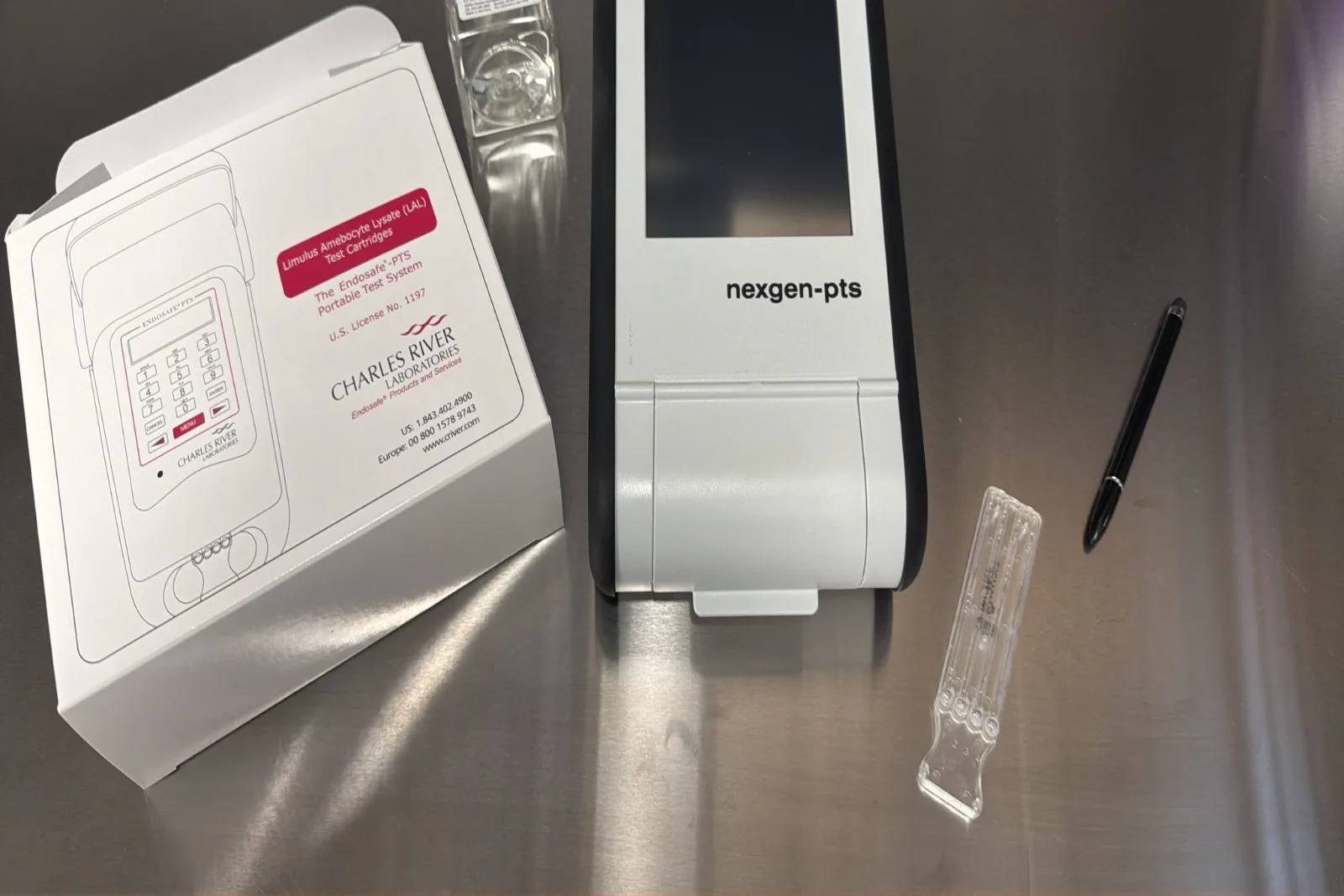
Three Charles River Endosafe nexgen-PTS readers with single-use cartridges. Each cartridge carries its own standard curve and is calibrated by Charles River before it ships, so there is no in-house standard curve to drift. The limit for a peptide is calculated from the intended dose per USP <85>, K/M, and printed beside the result so the pass is checkable.